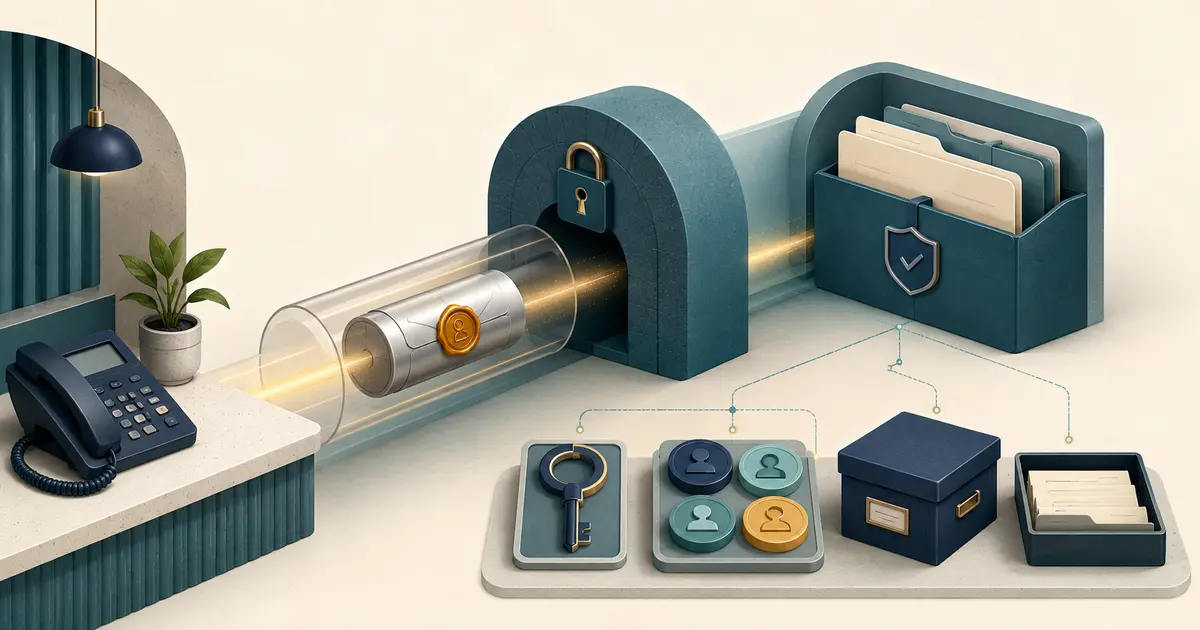
Dental call recording and transcription require separate legal, privacy, security, and operational review. HIPAA may apply when recordings or transcripts contain protected health information, but a BAA does not answer every consent or state recording-law question. Before enabling the feature, map the jurisdictions, purpose, notice, data flow, access, retention, and deletion with qualified counsel.
This checklist is educational, not legal advice.
Start with the business purpose
Define why the practice wants recording or transcription:
- quality review;
- training;
- request documentation;
- dispute investigation;
- accessibility support;
- automated summary;
- analytics;
- compliance monitoring.
Then ask whether the same purpose can be achieved with less data. A structured request may be sufficient where a full recording creates unnecessary risk.
The call tracking metrics guide offers non-recording measures for many operational questions.
Map every jurisdiction and party
Call-recording laws vary by state and situation. A call may involve the practice, employee, caller, vendor, and subcontractors in different jurisdictions. Ask counsel:
- which law applies;
- whether one-party or all-party consent is required;
- what notice and affirmative action are needed;
- how interstate calls are handled;
- whether inbound and outbound rules differ;
- whether employees require separate notice or agreement;
- how recording may be paused or declined;
- which exceptions apply, if any;
- what evidence of consent must be retained.
Do not copy a generic announcement from another business.
Separate audio, transcript, and summary
These are different records:
- audio contains voice, background speech, tone, and all captured content;
- transcript converts speech to text and can introduce recognition errors;
- summary selects and rewrites information and can introduce omissions or inferences;
- metadata includes numbers, timestamps, routing, participants, and technical events.
Define which records are needed, authoritative, editable, searchable, exportable, and retained. A corrected summary should not silently rewrite the original evidence.
Determine HIPAA roles and contracts
If a vendor creates, receives, maintains, or transmits PHI on behalf of a covered practice, it may be a business associate. HHS provides sample BAA provisions covering permitted uses, safeguards, reporting, subcontractors, and termination.
Map telephony, recording, transcription, AI, hosting, support, analytics, notification, and backup vendors. Ask whether data is used for model training or product improvement and under what authority.
The BAA checklist for dental answering services provides a relationship-focused review.
Limit access
Create roles for:
- front desk request review;
- manager quality review;
- clinical access when appropriate;
- privacy or incident investigation;
- administrator configuration;
- vendor support.
Use unique accounts, appropriate authentication, access logs, and periodic review. Avoid broad access merely because recordings are available. Control downloads and exports, which can outlive platform retention.
Set retention deliberately
Longer retention increases the amount of information exposed to error, unauthorized access, litigation, account compromise, and vendor failure. Short retention may impair an approved business or recordkeeping need.
Document:
- retention by record type;
- start event;
- legal and business rationale;
- deletion method;
- backup treatment;
- litigation or investigation holds;
- patient access or amendment process when applicable;
- termination export and deletion;
- owner and review date.
Do not accept “stored indefinitely” as a neutral default.
Handle transcript errors
Transcription can mishear names, numbers, medication terms, accents, or overlapping speech. Summaries can omit negation or confuse a request with a confirmation.
Require:
- visible indication that text is machine-generated when applicable;
- link to source audio for authorized review;
- correction workflow;
- original and corrected versions;
- author, time, and reason for correction;
- uncertainty markers;
- prohibition on treating an unreviewed transcript as a clinical conclusion;
- testing across realistic call conditions.
Missed Calls Dental captures requests for front desk follow-up; it does not diagnose, triage, verify benefits, or book appointments. A transcript does not expand that authority.
Control notifications
Recordings and transcripts may appear in email, SMS, browser notifications, mobile apps, and support tickets. Limit preview content and recipients. Avoid full transcripts in shared inboxes or lock screens.
Apply HHS minimum necessary principles to routine workflows and access roles. Have advisers determine the exact application to the practice.
The phone and voicemail privacy guide covers oral and message safeguards.
Plan incidents and patient requests
Define how the practice handles:
- recording without required notice;
- wrong caller or wrong patient association;
- unauthorized listening or export;
- transcript sent to the wrong recipient;
- vendor breach or outage;
- failed deletion;
- subpoena or legal hold;
- patient question or complaint;
- disputed transcript;
- employee misuse.
Preserve evidence, contain access, notify the right internal advisers, and follow the approved incident process. Do not let a frontline employee make a legal determination alone.
Test before launch
Using fictional callers, test:
- notice and consent path;
- caller decline path;
- pause/resume behavior;
- interstate test under counsel-approved plan;
- transcript accuracy for names and numbers;
- corrections;
- role access;
- downloads and audit logs;
- retention and deletion;
- vendor support access;
- outage and missing-record behavior;
- termination export.
Record the product version and configuration. Retest after a material vendor or model change.
Make a go/no-go record
Approve only when the practice has:
- documented purpose;
- legal analysis for notice and consent;
- data-flow map;
- vendor and BAA review;
- access roles;
- retention decision;
- correction process;
- incident plan;
- tested patient choice;
- trained staff;
- rollback.
Audit the full copy chain
A recording may be duplicated into a vendor console, cloud storage, quality-review tool, transcript service, email attachment, downloaded file, or backup. Draw the complete path rather than reviewing only the phone system. For every copy, name the business purpose, authorized roles, protection, retention rule, deletion method, and incident owner.
Test permissions with accounts for each role. Confirm that a former employee, generic shared login, or vendor support account cannot reach more content than intended. Review whether notification previews and filenames reveal caller information outside the protected system.
Set a correction and dispute process
Transcripts can misstate names, dates, numbers, medications, locations, and caller intent. Define whether the transcript is a convenience copy, a business record, or an input to another workflow. Staff should not silently overwrite an original or treat uncertain text as verified fact.
When an error matters, preserve the original, add an attributable correction, notify affected downstream owners, and document the final operational state. Provide a route for patient questions and employee escalation. The process should address summaries generated from transcripts as well as raw text.
Reassess after material changes
Repeat the review when the vendor, recording notice, supported jurisdiction, transcription model, retention setting, integration, or business purpose changes. A configuration approved last year does not automatically approve a new data flow. Maintain versioned evidence so the practice can show which controls applied at a particular time.
Schedule a periodic access and retention review even when the product appears operationally unchanged. Employee roles, support accounts, exported copies, and business needs can drift while the visible recording setting stays the same.
Call recording can support quality and documentation, but it also creates a durable copy of a sensitive conversation. The right question is not simply whether recording is possible. It is whether the practice can justify, govern, protect, correct, and delete every record it creates.